


A commercial wash along the Highway 80 corridor gets sequenced by elevation rather than done all at once. The customer-facing side happens before you unlock or after you lock up, and the sides and back get done during business hours when nothing loud is near the door. Substrate decides the method: synthetic stucco and painted panel get low pressure only, brick and flatwork can take real force, and metal wants a careful hand around fasteners.
Owners on this side of the parish usually put off having the building cleaned for the same reason, and it is not the money. It is the fear of a crew showing up, roping off the front, and costing them a day of business. That fear is reasonable, and it is also solvable. Nobody here can afford to close for a wash, so the scheduling problem has to be answered before the cleaning problem gets touched at all.
The Cladding Decides Everything Else
The first twenty minutes of any commercial job is a walk, not a wash, and the reason is that two buildings of identical size can need completely different treatment depending on what they are wearing. Getting this wrong is how a wall gets damaged, and it is why quoting a building over the phone from square footage alone is a bad habit.
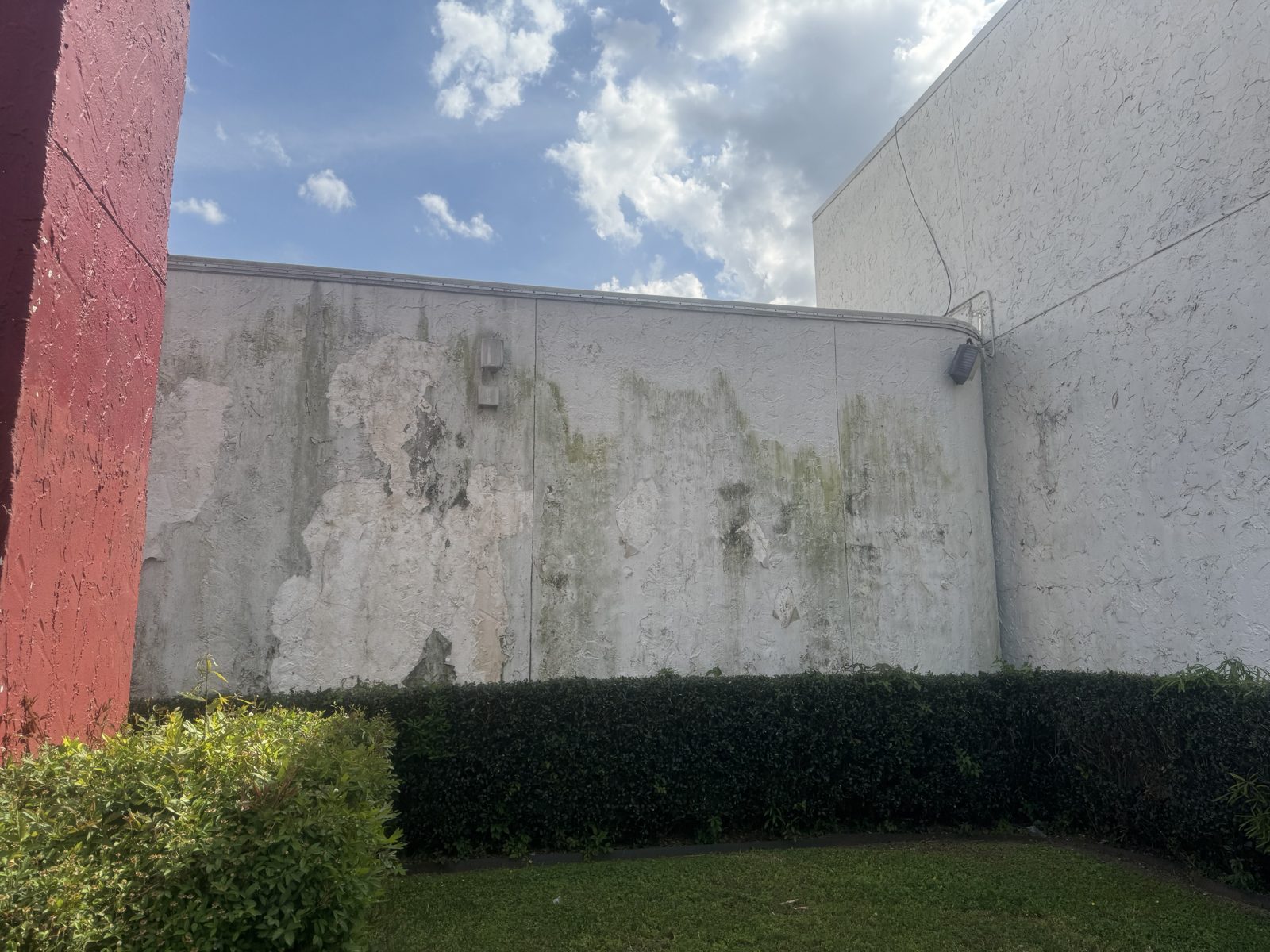
Synthetic stucco is the one that punishes carelessness hardest. It is a thin coating over foam board, and a pressure wand will either punch through it or drive water behind the wall to where the sheathing lives. It gets a low-pressure application only, with the cleaning solution doing every bit of the lifting and water doing nothing but rinsing. Painted panel and the trim bands on newer retail construction get the same treatment for the same reason.
Metal is different again. Plenty of the commercial stock out here is ribbed steel on a slab, and metal takes a wash well, but the ribs hold chalked paint and the fasteners will streak rust down a panel if they get hit wrong. That means washing top down at low pressure, keeping solution off bare fasteners, and rinsing the full run so nothing dries into a stripe halfway down the wall. Brick veneer and painted block, meanwhile, genuinely can take pressure, so those elevations get it.
Sequencing Around the Door Instead of Around the Clock
The trick is that a building is not one job. It is four or five elevations that can be handled at different hours, and once you think of it that way most of the scheduling conflict disappears. The customer-facing side is the only part that truly has to happen outside business hours. Everything else can proceed while people are inside, because nothing loud or wet is anywhere near the entrance.
Different businesses want different versions of that. A restaurant on the corridor wants us gone before the lunch line forms. A church wants the sanctuary entrance and the walks handled on Friday so Sunday morning is clean and dry underfoot. A school prefers the building addressed during a break week when the campus is quiet. A shop with bay doors mostly wants the front worked while the back stays open for business.
The mechanics of keeping it safe matter as much as the timing. The active zone gets coned and roped. Hoses stay out of the walking path rather than crossing it. Walks get squeegeed or blown dry behind the crew so nobody slips on the way in. And vehicles get moved or covered before anything starts, not after somebody notices overspray on a hood. Our Haughton building exterior washing page lays out the full commercial scope.
The Corners Customers Actually Stand Next To
A wall wash makes a building look sharp from the road, and the parts customers physically stand beside are usually the ones that got skipped. Dumpster pads are the worst offender. The slab absorbs whatever leaks out of the container all summer, and in this humidity it stops being a stain and becomes a smell that carries to the back door. Those pads want degreasing and a hot rinse, with the enclosure walls and gate done at the same visit so the whole corner reads finished instead of half-done.
Drive-thru lanes are the other one. A lane collects tire rubber, dripped oil, and spilled drinks in a narrow track, and the concrete darkens along that path until it looks like a different pour than the rest of the lot. A surface cleaner run down the lane produces an even finish, the oil spots get hit individually first, and the pad under the window needs scrubbing because hand-to-hand traffic leaves the heaviest marks there.
Signage is where a dirty building costs money directly rather than by reputation. A channel-letter set or a monument sign at the road collects pollen, webbing, and dust, and it goes dull long before anyone consciously notices. Cleaning the face and the returns is a short job that changes how the whole property reads at forty-five miles an hour. Awnings ride along with it, cleaned by soft solution top and bottom, never by pressure that would separate the seam stitching.

Why the First Wash Is the Dramatic One
A good share of the commercial stock along this corridor went up during the growth of the last several years, and buildings from that period are now old enough to show it. The algae line at the drip edge is the first tell. Traffic film around the doors is the second. Most of those owners have never had the exterior cleaned even once, which is exactly why the first wash produces the biggest visible change.
It is also why a single wash is not a strategy. The humid subtropical climate here does not take a season off. Growth reestablishes on a shaded north wall inside a couple of years of being cleaned, and pine pollen coats everything under the canopy each spring. A wall washed once and forgotten returns to where it started, and the second cleaning is harder than the first would have been.
A recurring plan is deliberately simple to set up. Agree on what gets cleaned and how often, put the visits on the calendar for the year, and hold the rate for that term. Nobody at your business has to remember to call. If the building has multiple tenants, the notice gets coordinated so nobody is startled by a crew at their glass, with one point of contact on each side.
The Paperwork Nobody Asks For Until They Need It
Documentation comes with a commercial visit whether it gets requested or not, and there is a practical reason. The written scope by elevation goes out before the work starts, so there is no argument later about what was included. The insurance certificate is available on request rather than after somebody asks twice. And photos of every face get taken at close-out.
Those photos earn their keep in specific situations. A church board wants to see what the money bought. A school administrator has to report it. An owner with an off-site landlord needs to show the property was maintained. In every one of those cases, a folder of before and after images by elevation settles the question in about ten seconds.
Weather runs the calendar out here more than anything else, and honesty about that is part of the service. A wet week or a hard freeze pushes a job, and moving it beats washing into rain and leaving a streaked wall behind. When a reschedule happens, it comes the day before with a new date attached, not the morning of with an apology. Finished commercial work is in the project gallery if you want to see the standard before calling.
Common Questions
Will you have to shut down our drive-thru?
No. A lane gets cleaned before opening or after the last car, which is a couple of hours of work rather than a shutdown. It is dry and usable well before the first customer of the day pulls in.
Can a metal shop building be washed without stripping the paint?
Yes. Ribbed steel comes clean at low pressure with the solution doing the work. What damages a metal building is a wand held too close and fasteners hit head on, which is what starts rust streaking down a panel.
How often does a building along the corridor need washing?
Once a year suits most buildings in this parish. A shaded north wall, anything sitting under pine, and buildings catching red clay off a gravel edge usually want a mid-year pass on that one face rather than a full repeat.
Put Your Haughton Building on the Route
Free, no-obligation quote with a written scope by elevation, insured crew, and work sequenced around your open hours.
Schedule a Wash Call (318) 401-2772The full commercial scope is on our Haughton building exterior washing page, finished properties are in the project gallery, and you can send us the address for a same-business-day reply.