
Greenwood Brick and Block Restoration
Brick ranch homes, block foundations, retaining walls and the column holding up the mailbox. We clean brick and concrete block with chemistry matched to each stain, try it on a small spot first, and keep mortar, windows and flower beds protected. Free quote, no travel fee, and a Marshall crew that knows what a wash will and will not fix. Call (318) 401-2772.
Four Stains Brick Picks Up
Each one comes off with a different mix, which is why we look before we spray.
Green Growth on Shaded Walls
Brick that sits in the shade of pines and big hardwoods stays damp, and algae roots into the rough face of every brick. A soft solution kills it down in the pores, then a rinse carries it off. Pressure on its own peels the top layer and leaves the rest to regrow.
The Red Clay Splash Band
Rain hitting bare soil throws red clay up onto the bottom courses of brick. Left alone, that band soaks in and turns the lowest foot or two of the wall a rusty orange. Plain water barely moves it. It takes a cleaner made for iron staining, worked in and rinsed well.
White Salt Bloom
That chalky white crust is efflorescence: salts carried out of the brick and mortar by water moving through the wall. The right cleaner takes it off. It returns if water keeps finding its way into the wall, and we will point to where that water might be coming from.
Rust Marks
Sprinkler heads aimed at the wall leave orange arcs, and metal fixtures, hose reels and old brackets bleed rust streaks below them. Each mark gets spot treated with a rust remover and rinsed thoroughly so it does not leave a pale patch behind.
Why Brick Holds a Stain
Brick looks solid, but it is full of tiny pores, and so is the mortar holding it together. Water soaks in, carries whatever is dissolved in it, and leaves that behind when the wall dries out. That is how a splash of red clay turns into a stain, and how a little mildew on the face ends up living just below it.
It is also why blasting brick with high pressure is a bad trade. The hard outer skin of a brick is its protection. Strip it, or cut into soft mortar, and the wall drinks in more water than it did before, so it stains faster the next time around. Older homes carry the most risk, since their mortar has already taken decades of weather.
We clean brick at the lowest pressure that does the job and let chemistry handle the rest.
In a climate this humid, a wall that keeps its skin stays cleaner for longer.
Our brick and block restoration page walks through the full process.
A Long Wall of Red Brick
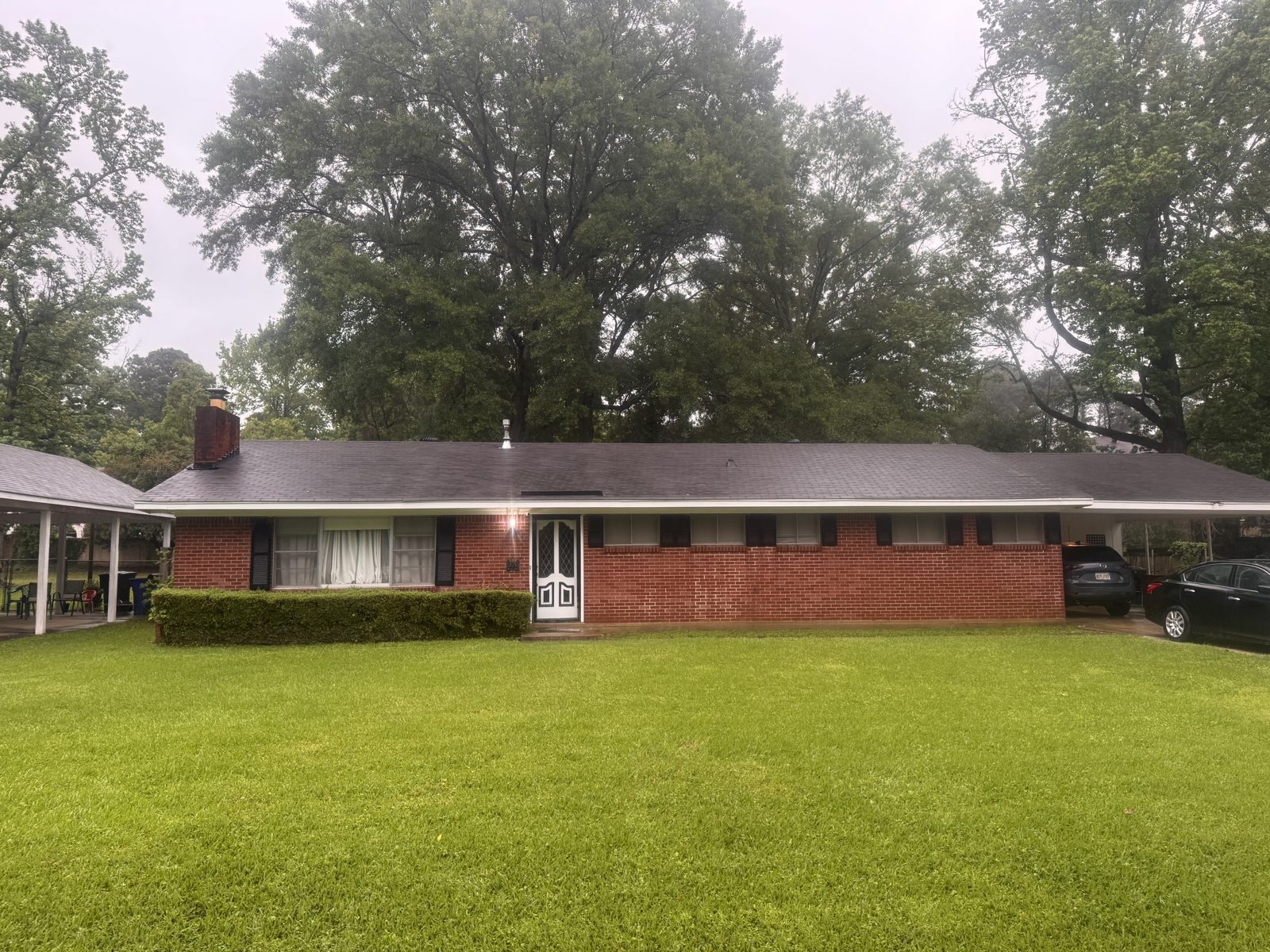
A ranch house like this one puts a lot of brick at eye level, and every stain on it shows from the road. The walls run long and low, the hedge sits close to the foundation, and the trees behind keep part of the house shaded through the afternoon. That combination is common on the brick ranch homes around Greenwood.
We work a house like this one wall at a time. The hedge gets soaked first, the windows and white fascia get rinsed so no cleaner dries on them, and the brick gets treated from the bottom up so streaks cannot form. The final rinse runs top down. Then one of us walks out to the street to check that the wall reads even from where your neighbors see it.
Block Walls Around the Property
Concrete block shows up in more places than people notice. It sits under plenty of brick houses as the foundation, holds back a slope or a raised bed as a retaining wall, makes up the walls of a detached shop, and gets stacked into the column at the end of the drive that carries the mailbox. Block is even more porous than brick, so it stains deep and it stains fast.
Retaining walls tend to be the worst of the bunch, since soil and water sit right behind them and push moisture through the block. Expect green growth on the face and white bloom along the joints. Shop walls collect red clay where trucks pull in, and mailbox columns wear grass clippings from the mower and sprinkler stains from the yard.
Painted block is a different job from bare block. Sound paint gets a gentle cleaning. Peeling paint will shed loose flakes in the rinse, and we tell you that up front so you can decide whether a fresh coat should follow.
Test a Spot, Then the Wall
We never put a new mix on a whole wall before seeing what it does. Every job starts with a small test area, usually low on a back corner, where we try the cleaner we think fits the stain and check the result once it is rinsed and drying. If it lightens the brick or leaves a haze, the mix changes before we go any further.
Protection starts before the test, too. Glass and painted trim stay wet while we work so nothing can dry on them. Light fixtures and outdoor outlets get covered. On older walls we stand farther back and use a wider spray tip so the mortar joints do not get carved out.
Most brick takes several passes with different mixes: one for the growth, one for the clay, one for any rust. That is slower than a single hot blast, and the wall comes out looking better for the patience.
Where a Wash Stops
Cleaning brick makes it look a lot better, and sometimes it reveals problems the dirt was hiding: cracked mortar, missing joints, brick faces that have flaked off, or a stair-step crack running up a wall. We do not repair masonry or tuckpoint, and a wash fixes none of those.
What we do is point them out as we find them, take a photo, and tell you plainly. If mortar is soft enough that cleaning could make it worse, we skip that section and explain why. A good mason can take it from there, and the wall will already be clean when they arrive.
A few habits keep the brick looking right afterward. Cover bare dirt along the foundation with mulch or rock so hard rain has nothing red to throw against the wall. Turn sprinkler heads so they water the yard and miss the house. Keep gutters running clear, since an overflowing gutter soaks the same stretch of brick every storm. Trim shrubs back from the wall a little so air can move behind them and dry the brick after a wet morning.
See the Brick We Have Cleaned
The gallery has brick, block and flatwork from jobs around the region. Describe your walls and the stain that bugs you most, and we will set a time to come look.
The Rest of Our Greenwood Work
Brick days often pair well with one of these.
What Homeowners Ask About Brick
Will cleaning damage the mortar on my brick house?
Not the way we do it. We use the lowest pressure that cleans, a wide spray tip, and chemistry that lifts the stain so the water only has to rinse. Older or soft mortar gets extra care, and if a section looks too weak to wash, we tell you and leave it alone.
Can you get red clay stains off the bottom of my brick?
Usually, yes. Red clay is iron staining, so it needs a cleaner made for iron instead of plain water or bleach. We test it on a small area first. Very old stains that have soaked in deep may lighten a lot without vanishing completely, and we will say so before we start.
What is the white powder on my brick?
That is efflorescence, salts pulled out of the brick and mortar as water moves through the wall and dries on the surface. We can clean it off. If it keeps coming back, water is getting into the wall somewhere, and we will show you the likely spots to check.
Do you clean concrete block retaining walls and foundations?
Yes. Block foundations, retaining walls, shop walls and mailbox columns all get the same careful approach as brick: protect the beds, test a spot, then treat the stain. Retaining walls often need a second pass, because moisture keeps pushing through from the soil behind them.
Do you do tuckpointing or masonry repair?
No. We clean brick and block, and that is all we claim to do. If we find cracked or missing mortar, loose brick or other damage while we work, we photograph it and point it out so you can have a mason take a look at it.
How do you protect my windows and flower beds?
Beds get soaked with plain water before any cleaner goes on the wall, then watered again after the rinse. We keep window glass wet the entire time so no cleaner can dry and spot it. Outdoor outlets and light fixtures get covered before the first spray goes on.
Give the Brick Its Color Back
We look at every wall and every stain before we price it, and the quote is free with no obligation attached. Send us the address and a note about what you are seeing on the brick.