

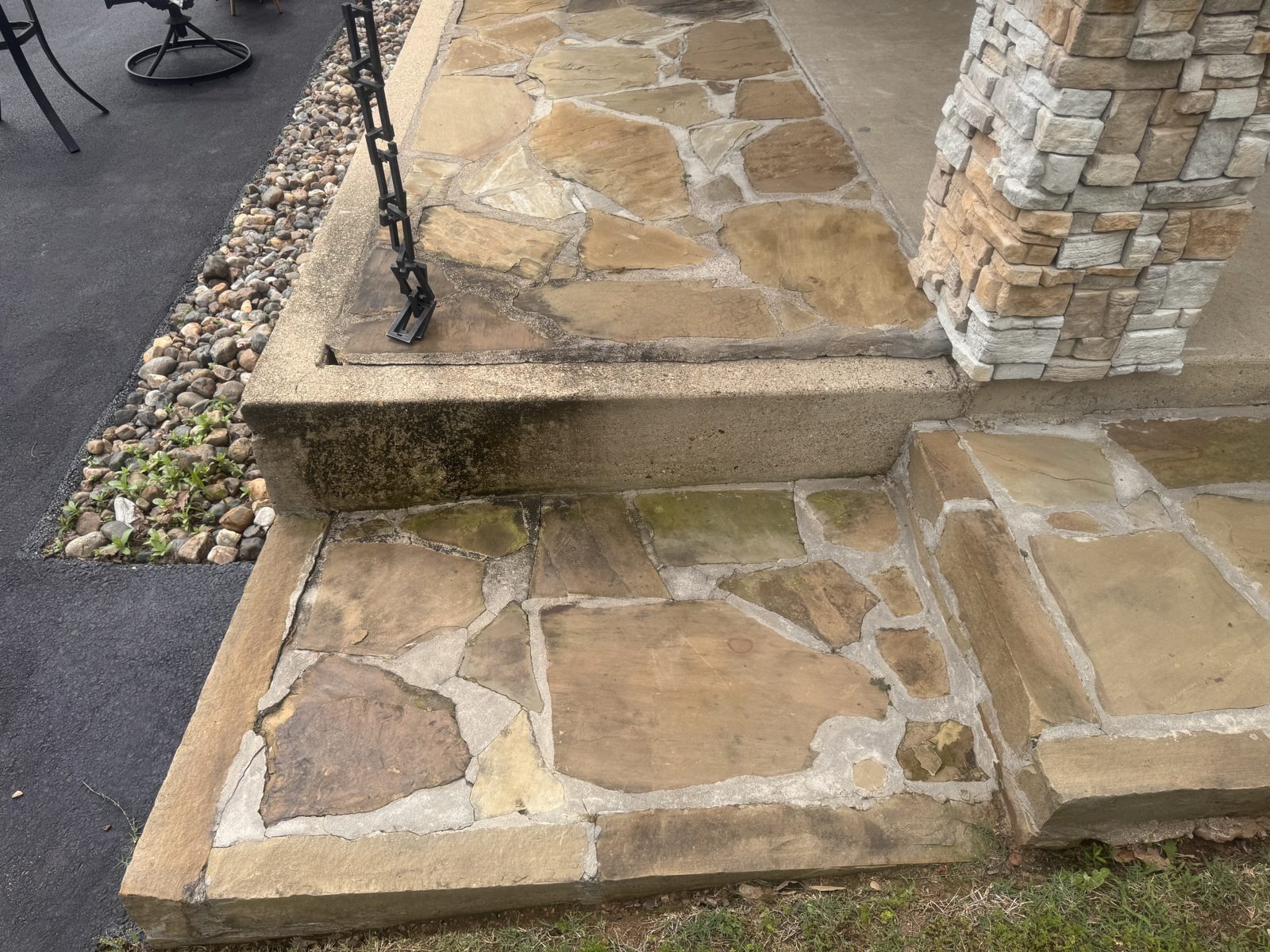
On a set of flagstone steps, the concrete riser and the lowest stones go green first because they stay wet longest and sit closest to the ground. The stone itself handles a wash well. The mortar between the stones does not, so we clean flagstone with solution, a short dwell and a low, wide rinse that never digs into the joints.
Flagstone steps dress up the front of a house, and they are usually the first thing on it to look tired. Homeowners tell us the same story every spring. The stones looked fine last year, and now the face of one step is dark green, the bottom flagstones are slick, and the gray mortar has a green tint down in the lines. It happens fast on a shaded lot in Greenwood, and the order it happens in tells you a lot about how to clean it.
The Riser Goes Green Before the Stones Do
Look at a set of steps with growth on it and the vertical concrete face of a step is usually the worst spot. That riser stays damp longer than anything around it. The tread above throws a little shade on it all day, rain runs off the front edge and down its face, and concrete is porous enough to hold that water in for hours.
A riser that faces away from the afternoon sun can stay damp from one rain to the next in a humid stretch. Algae only needs that steady moisture and some shade, and the tall pines and oaks that cover so many lots around town supply the shade for free. The growth starts as a faint green haze along the bottom of the riser and spreads up until the whole face reads dark from the driveway.
The flagstone tread right above it often looks cleaner, simply because a stone top gets more sun and dries faster than a concrete face tucked under it.
Why the Lowest Flagstones Follow
The stones at the bottom of a run of steps are next in line. They sit lowest, so every rain drains down onto them, and dirt washed off the upper steps settles on them. If there is a bed of river rock or mulch beside the walk, the ground there stays wet and the bottom stones never fully dry out between storms.
A rain chain adds its own spot. It is a nice way to bring water down off a roof, and it also delivers that water to the same few square feet of ground every single time. Stones near the base of a rain chain tend to grow green in a ring around where it lands.
Pollen joins in each spring. The yellow dust settles into the rough surface of the stone, holds moisture against it, and gives algae something to feed on. That is when steps go from a little green to slick, and a slick flagstone after a rain is a fall waiting to happen.
Mortar Joints Are the Weak Point
Flagstone is tough. It has spent a long time in the ground already, and a wash at sensible pressure does it no harm. The mortar holding the stones in place is a different material, and it is the part we worry about on every set of steps we clean.
Mortar is softer than the stone and more porous. A tight pressure tip run along a joint will eat into it, open the line wider, and in older work it can lift out a whole section. Once the joint is open, water gets under the edge of the stone, and every heavy rain after that works it a little looser. We have seen steps that were washed by someone with a rental machine and a narrow tip, and the damage looks like the steps aged ten years in an afternoon.
Green growth lives down in those joints too, so they still need cleaning. They just get chemistry and a gentle rinse to do the work, with no force behind it. A joint that already has gaps or loose pieces gets pointed out to you before we wash, because a rinse can carry off mortar that was only hanging on.
How We Wash Stone Set in Mortar
We start by clearing the steps and the patio around them. Chairs, grills, planters and the doormat get moved off and set aside, and they go back where they were when the stone is dry enough to walk on.
Then the stone, the riser and the joints all get a cleaning solution applied at low pressure. It sits for a few minutes so it can kill the growth down in the texture of the stone and in the mortar lines. The rinse uses a wide fan held back from the surface and run along the joints, never across them at close range. On flat patio sections we can use a surface cleaner set low, and the steps and edges get done by hand. Our Greenwood patio cleaning page covers flagstone, poured concrete and stone patios in full.

Stone Columns, Rain Chains and the Slick Season
Steps rarely stand alone. A stacked stone column or veneer wall often sits right beside them, and it collects the same green along its base. Those get the same gentle treatment, with extra care in the deep gaps between the stacked pieces where loose bits can be knocked free. Brick walls and block retaining walls nearby run on different chemistry, and our Greenwood brick and block restoration page goes through how we approach them.
Timing helps the stone stay clean longer. A spring wash takes the winter growth off before pollen builds on top of it, and an early fall wash clears a summer of humidity before the wet months. Between washes, sweeping the steps and keeping the beds beside them from piling against the stone slows the green down. You can see finished steps and patios in our project gallery.
Common Questions
Will pressure washing damage my flagstone steps?
The stone holds up fine. The risk is the mortar between the stones, which is softer and opens up under a narrow tip held close. We clean the joints with solution and a wide, gentle rinse run along them, so the growth comes out and the mortar stays where it was set.
Why is only the bottom step so green?
It stays wet the longest. Rain drains down the whole run onto the lowest stones and the riser above them, dirt from the upper steps settles there, and nearby beds keep the ground damp. Add shade from overhead trees and the bottom step grows green well before the top one does.
How long before the steps turn green again?
That depends on shade, drainage and how much pollen lands on them. Steps under heavy tree cover with a rain chain nearby come back faster than steps in open sun. Sweeping, trimming plants away from the stone and booking a wash in spring or early fall all stretch the time between cleanings.
Steps You Can Walk On Wet
No-obligation quote after we look at the stone, the joints and whatever sits around them.
Schedule a Wash Call (318) 401-2772Flagstone, concrete and covered patios are all on our Greenwood patio cleaning page, the full list of what we do in town sits on the Greenwood service page, and you can reach us through the contact form with a photo of the steps.