
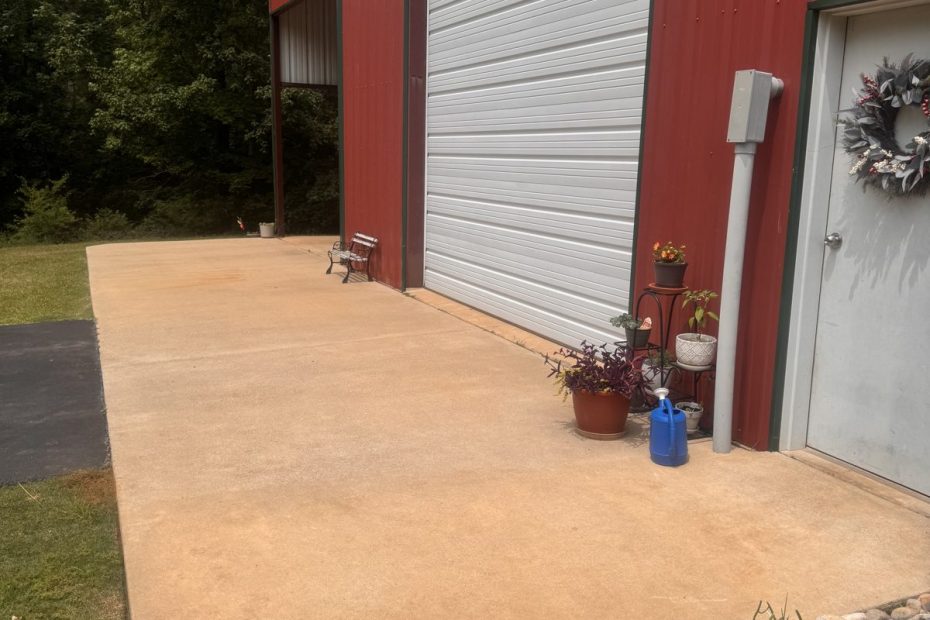
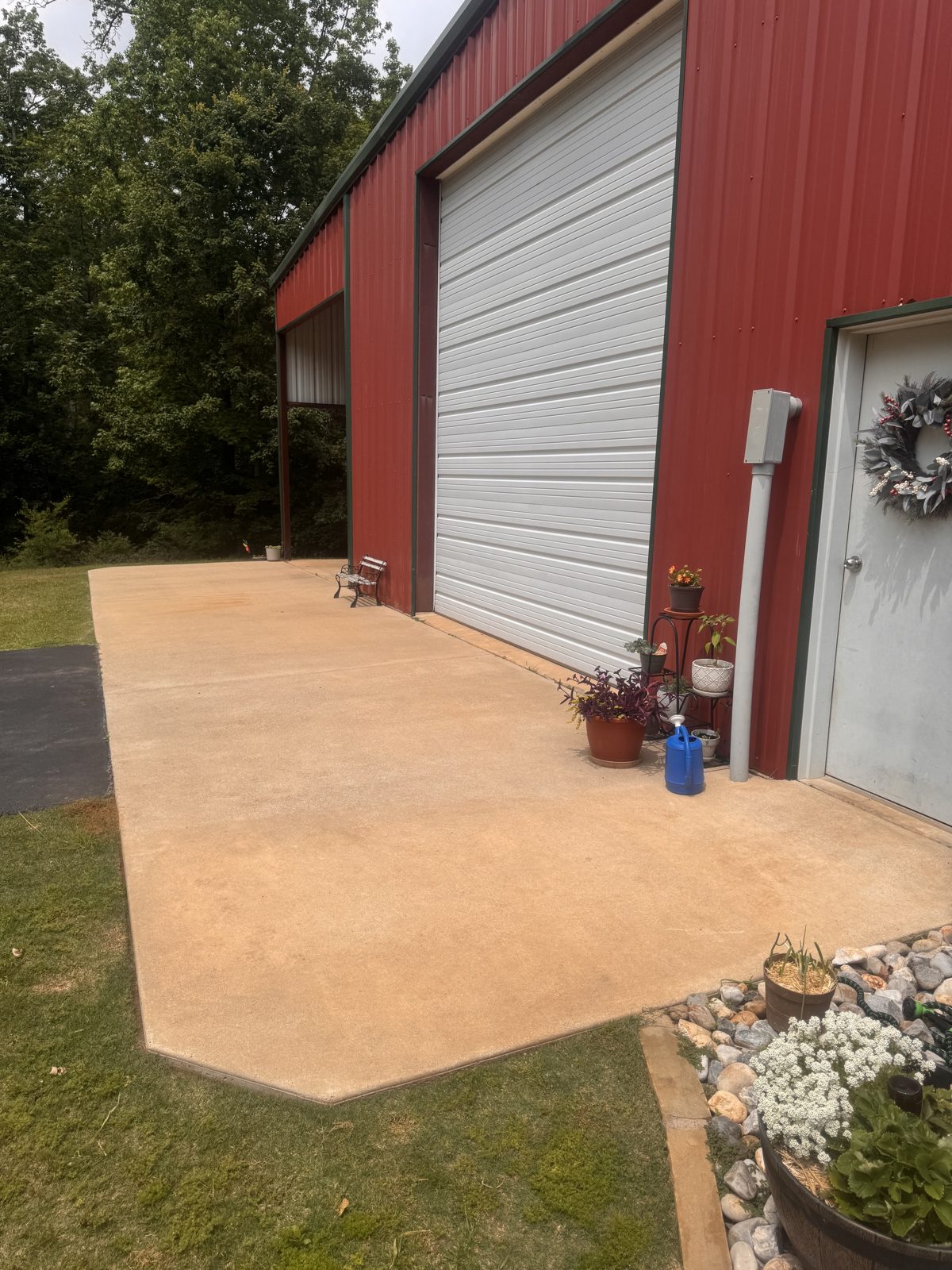
A rental wand puts all its force in one narrow line, so sweeping it across a broom-finish slab leaves light and dark bands that show for years. A rotary surface cleaner spreads that force flat and gives you one even tone. On sealing, humidity decides: a film coat traps vapor pushing up from underneath and clouds or lifts, so a penetrating sealer is the safer bet on anything that stays damp around here.
Driveway calls tend to arrive after a Saturday project. Somebody borrowed a machine, spent four hours on the slab, and the result is either stripey or the orange never budged. Both outcomes have specific causes, and neither means the concrete is beyond help. The tool and the chemistry are separate problems, and getting one right while missing the other is why so many slabs around here look half-cleaned.
The Zebra Stripes Come From the Tool
A wand concentrates everything the machine produces into a single narrow line. Sweep that line back and forth across a slab and two things happen. The passes never overlap perfectly, so you get bands of cleaned and less-cleaned running the direction of the sweep. And the edges of each stroke cut differently than the middle does, which puts a seam at every overlap.
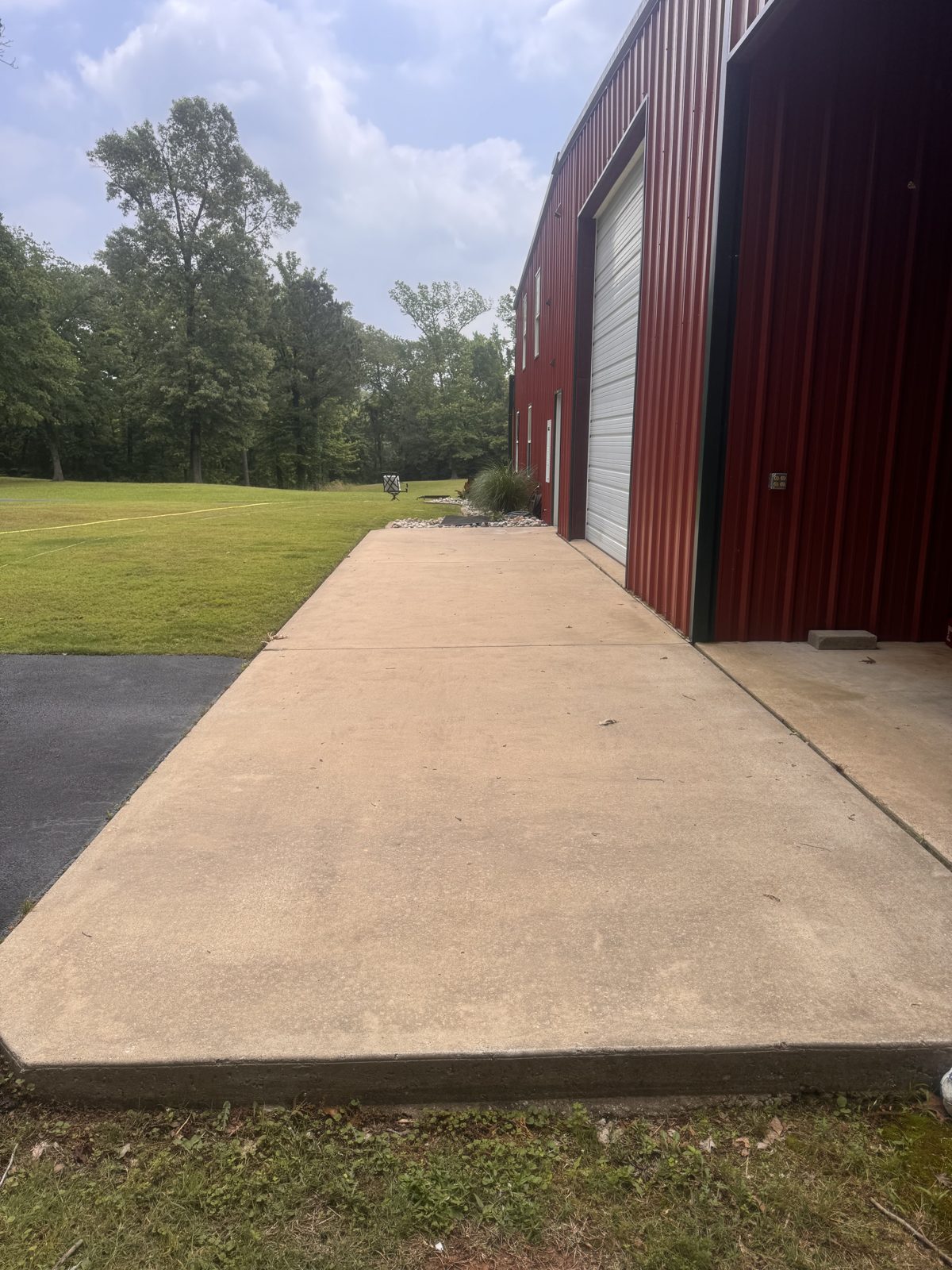
On a smooth slab you might get away with it. On the broom finish that most driveways around here carry, those bands catch light at an angle and stay visible for years. We get called out to correct that work often enough that we recognize the pattern from the street before pulling in.
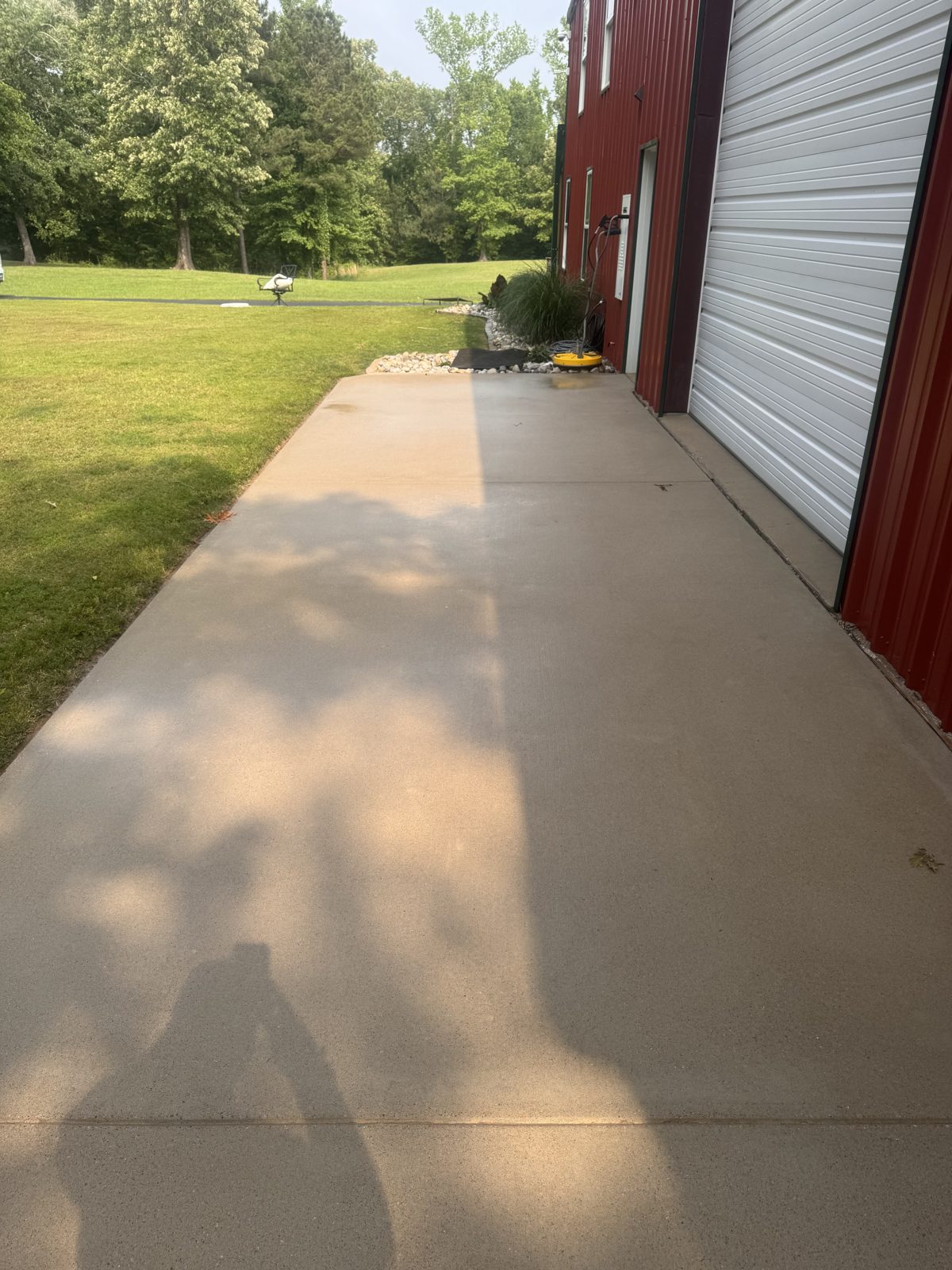
A rotary surface cleaner solves it mechanically rather than by technique. Two jets spin inside a housing that rides flat on the slab, so the force lands evenly across the entire width of the pass instead of along a line. The result is one uniform tone from the garage door out to the street. It also moves considerably faster, which matters on the long driveways in the newer subdivisions.
The wand still has a job, just a smaller one. It cuts the trim work a housing cannot physically reach: the edge against a flower bed, the corner where a walk meets the porch, the joint lines, the curb face. Those run by hand at lower pressure and a wider fan so the finished edge blends into the surface-cleaned field rather than standing out as a bright border around the whole slab.
Four Marks, Four Different Answers
A typical driveway around here reads in zones, and each zone is a different chemistry problem. The tire path darkens where rubber and road film get ground into the surface. The apron by the street collects the heaviest clay. The stretch beside the garage picks up drips. And the shaded strip along the north side goes green and turns slick after a rain.
Red clay is a pigment stain, not loose dirt, which is why a garden hose spreads it around instead of removing it. It answers to a tannin remover given a few minutes to work. Rust is a metal stain and needs an acid built for iron, which is a different bottle entirely. Sprinkler heads throw it in a fan shape, iron furniture leaves rings under the feet, and fertilizer with iron in it speckles a whole apron after the first watering.
Oil behaves opposite to all of them. It is not sitting on the slab, it has wicked down into the pores, and pressure alone drives it deeper rather than lifting it. A degreaser has to break it up and float it back to the surface, which takes dwell time and sometimes a second application on an old spot under a work truck. Anybody promising one product handles all four is describing a single pass, not a plan. Our Haughton concrete cleaning and sealing page breaks the sequence down.
Age Decides What Comes All the Way Out
This is the conversation nobody enjoys and everybody would rather have in the driveway than after a deposit changes hands. A clay splash from this spring lifts completely. A rust ring that has been bleeding under a planter for six years lightens to a shadow and stops there. Those are both normal outcomes and it helps to know which one you are looking at before the work starts.
Tire marks are their own category and get misread constantly. Part of a black tire mark is deposited rubber, which comes off. Part of it is abrasion, where the tire physically wore the surface, and abrasion is not a stain at all. Nothing removes it, because there is nothing sitting there to remove. The slab has simply been reshaped in that spot.
So we walk the slab first, point at each zone, and say plainly which ones return to original color and which ones only lighten. Then it goes on the quote in those words. It costs a job occasionally, when somebody wants to hear that a six-year rust ring will vanish. We would rather lose that one than have the conversation afterward, and around here most of the work comes from somebody’s neighbor anyway.
Penetrating Versus Film, Settled by the Weather
Sealers fall into two families that fail in completely different ways. A penetrating sealer soaks into the pores and reacts down inside the concrete. The slab afterward looks the way it does on a dry afternoon, with no shine, no color shift, and no change underfoot. A film sealer lays a coat on top, deepens the color into a wet look, and adds gloss.
Humidity is the tiebreaker in this parish. A film sitting on top of a slab has to contend with moisture pushing up from underneath every humid week. If that vapor cannot pass through the film, it collects beneath the coating and turns it cloudy or lifts it in patches. Shaded concrete under pine, where the slab never fully dries between rains, is the worst possible place to bet on a film.
There is also a safety consideration people do not think about until they are standing on it. A film gets slippery when wet, which rules it out for walkways and for the step down to a patio. So penetrating is the default on driveways, walks, and anything that stays damp, and the wet look gets saved for covered patios and decorative work where the finish is the point and the surface stays dry underfoot. If you want to see the difference instead of imagining it, we wet a small square on the day so you can compare it against the dry concrete beside it.
Dry Time, Cure Time, and Getting the Cars Back
Sealing is a second trip, and the reason is physics rather than scheduling convenience. Concrete holds water deep in the pores long after the top feels dry to a bare foot. Put sealer over a slab that is still wet inside and the moisture has nowhere to go, so it hazes the finish or pushes the coat loose within a season. In this humidity that usually means a day or two after the wash, longer on a shaded north side, and we check moisture rather than counting days on a calendar.
On sealing day we start in the morning so the surface has the warm part of the day to set up. Foot traffic is fine the same evening. Vehicles wait until the following day. If the driveway is the only way in or out, that gets planned before the booking rather than discovered on the morning: park at the curb overnight, or we split the slab and do one half at a time so you keep a lane the whole time.
Once cured, the sealer is doing two jobs. Water soaking into open pores expands when a cold snap comes through the parish and pops flakes off the surface, which is where the pitting on older unsealed driveways begins. A sealed slab keeps most of that water out. It also buys time on the next stain, because clay and oil that used to sink in now sit on top where the following wash takes them off easily. Results from around the parish are in the project gallery.
Common Questions
Why did my driveway look worse after I washed it myself?
Almost always the wand. Sweeping a narrow high-force line across a broom finish leaves bands where the passes did not overlap evenly, and those bands catch light for a long time. A rotary surface cleaner spreads the same force flat, which is what produces one even tone.
Will sealing stop the green strip in the shade from coming back?
It slows it down considerably. Growth roots into open pores, so sealing them closed removes the foothold. We still treat the existing growth chemically at low pressure first, because sealing over live algae just locks it under the coating.
How soon can I park on a freshly sealed driveway?
Foot traffic the same evening, vehicles the next day, which is why we start in the morning. Tell us at booking if the drive is your only access and we will seal it in halves so you always have a lane to use.
Get an Honest Read on Your Haughton Slab
Free, no-obligation quote that says which marks lift and which only lighten, before anybody unrolls a hose.
Schedule a Wash Call (318) 401-2772The full process is on our Haughton concrete cleaning and sealing page, finished slabs are in the project gallery, and you can send photos of the worst zone for a same-business-day reply.