
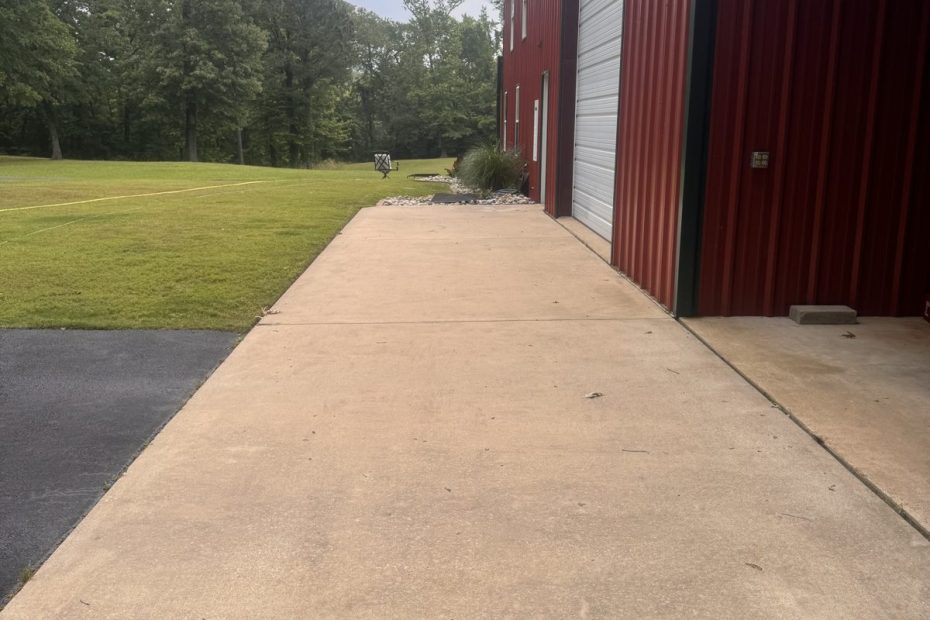
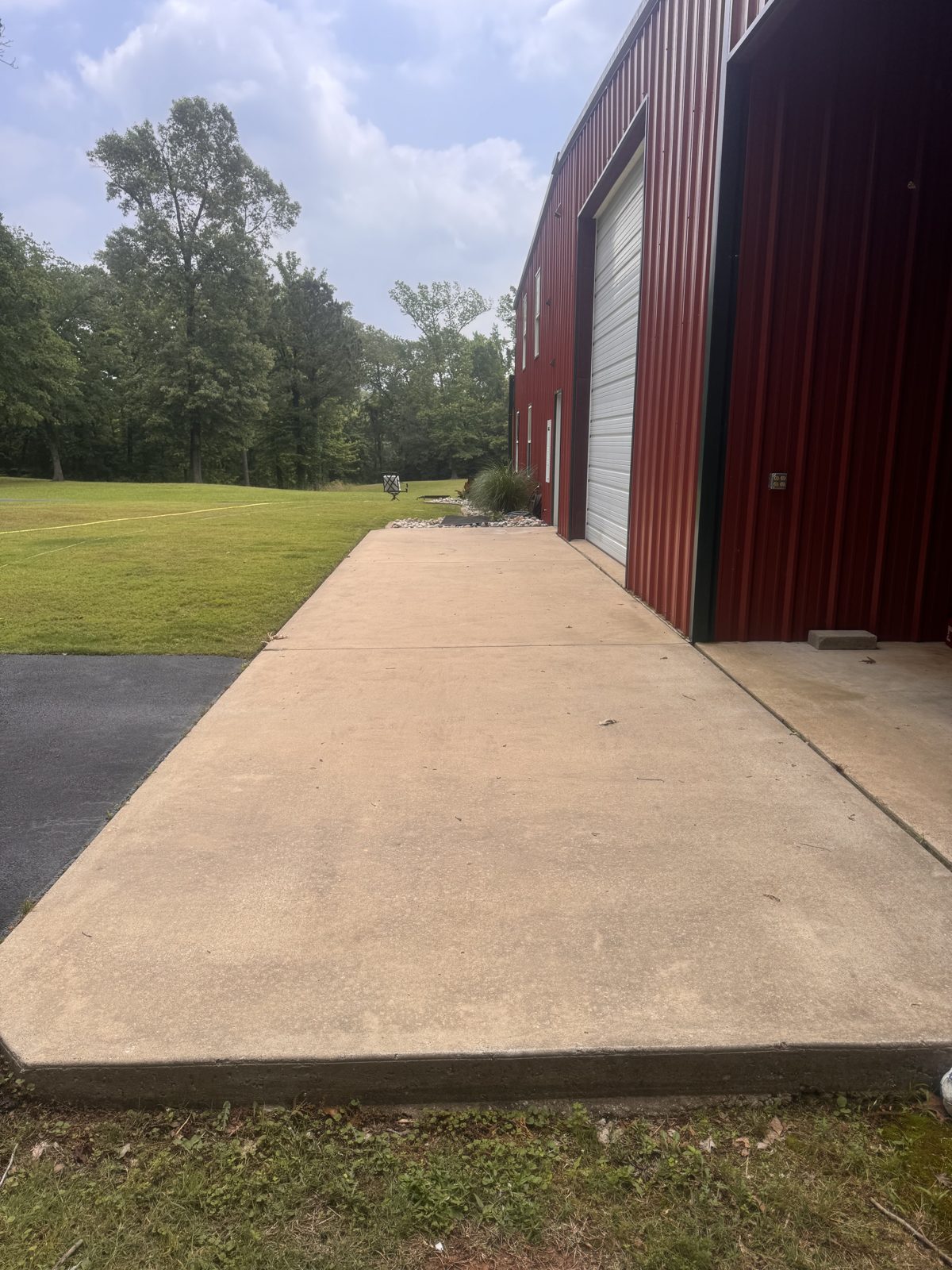
A clean driveway and an evenly clean driveway are two different results, and the difference is technique. A surface cleaner has to overlap every pass or it leaves zebra striping down the slab. A broom finish holds dirt deeper in its texture than a smooth trowel does and takes longer. And the surface cleaner only ever does the field: the edges, the control joints, the walkways and the seam where concrete meets asphalt all need a wand afterward, which on a long rural drive is most of the day’s work.
We get called out to plenty of driveways that have already been washed once, sometimes by the homeowner with a rented machine and sometimes by somebody who charged for it. The complaint is almost never that the concrete is dirty. It is that the concrete is striped, or that the middle looks great and the edges look untouched, or that a hard line runs across the slab where somebody stopped for lunch. A wand stripes no matter who is holding it. A surface cleaner only stripes when the passes do not overlap, and that is the version we see most.
Zebra Striping Is an Overlap Problem
A surface cleaner is a spinning bar with two or four nozzles under a shroud, and it cleans a circle that is slightly narrower than the housing suggests. Push it in a straight line and it cleans a clean band. Push the next line beside it without overlapping, and the strip between the two bands never gets fully hit.
Wet concrete hides this completely. Everything looks uniform and dark while the water is on it. The stripes appear as the slab dries, which is usually twenty minutes after somebody has packed up and left, and by then they are set in as a visible pattern of light bands and darker lines running the length of the drive.
Fixing it after the fact is harder than doing it right, because now you are trying to match a cleaned surface rather than cleaning a dirty one. The answer is overlapping every pass by a few inches, keeping a steady walking speed so the bar dwells the same amount everywhere, and never stopping mid-slab. A pause leaves a bright spot that shows up as clearly as a stripe.
Broom Finish and Smooth Trowel Take Cleaning Differently
Concrete is not one surface. Most residential drives out here got a broom finish, which means the fresh concrete was dragged with a broom to leave fine parallel ridges for traction. Those ridges are exactly where dirt, pollen and organic growth settle, and they shelter it from a straight-on spray.
A broom finish needs the bar run in more than one direction, or at least a direction that works across the grain of the texture rather than along it, and it needs a slower pass. The texture is doing its job by holding things, including the things we are trying to remove.
A smooth trowel slab is the opposite. Garage aprons, some porches, and a lot of interior-adjacent flatwork got troweled smooth, and they release dirt quickly. They also show every inconsistency in the cleaning, because there is no texture to break up the eye. A smooth slab is faster to clean and far less forgiving of a missed overlap.
The Field Belongs to the Surface Cleaner
The open middle of a slab is what a surface cleaner is for, and on a long rural drive that is a lot of ground. The shroud keeps the water contained so it is not throwing dirt onto the siding or the car, the spinning bar gives an even dwell across the whole width, and the result on a straight run is a consistent finish no hand wand can match.
Pattern matters as much as overlap. We work the field in a planned direction, usually with the fall of the slab so water and loosened material move away from where we are standing rather than back across cleaned concrete. On a drive with a crown that means working each side separately.
Running a wand across an open field instead is what produces the other classic result: a slab covered in fan-shaped arcs, each one a little different in brightness, like a signature written across the concrete.
Edges, Walkways and the Seam Where Concrete Meets Asphalt
Everything the housing cannot sit flat on gets done by hand after the field is finished. The perimeter is first, because a surface cleaner physically cannot reach the last inch against a garage threshold, a foundation wall, a curb, or a planting bed border. That untouched inch frames the whole drive and makes a good job look careless.
Control joints and cracks need the same treatment. They collect fine sediment that a bar passing over the top does not lift, and a clean slab with dark joints still reads as dirty from the road. Flagstone, pavers, stacked stone column bases and river rock borders are all hand work too, because an irregular surface under a flat shroud means the bar hits the high spots and misses everything else.
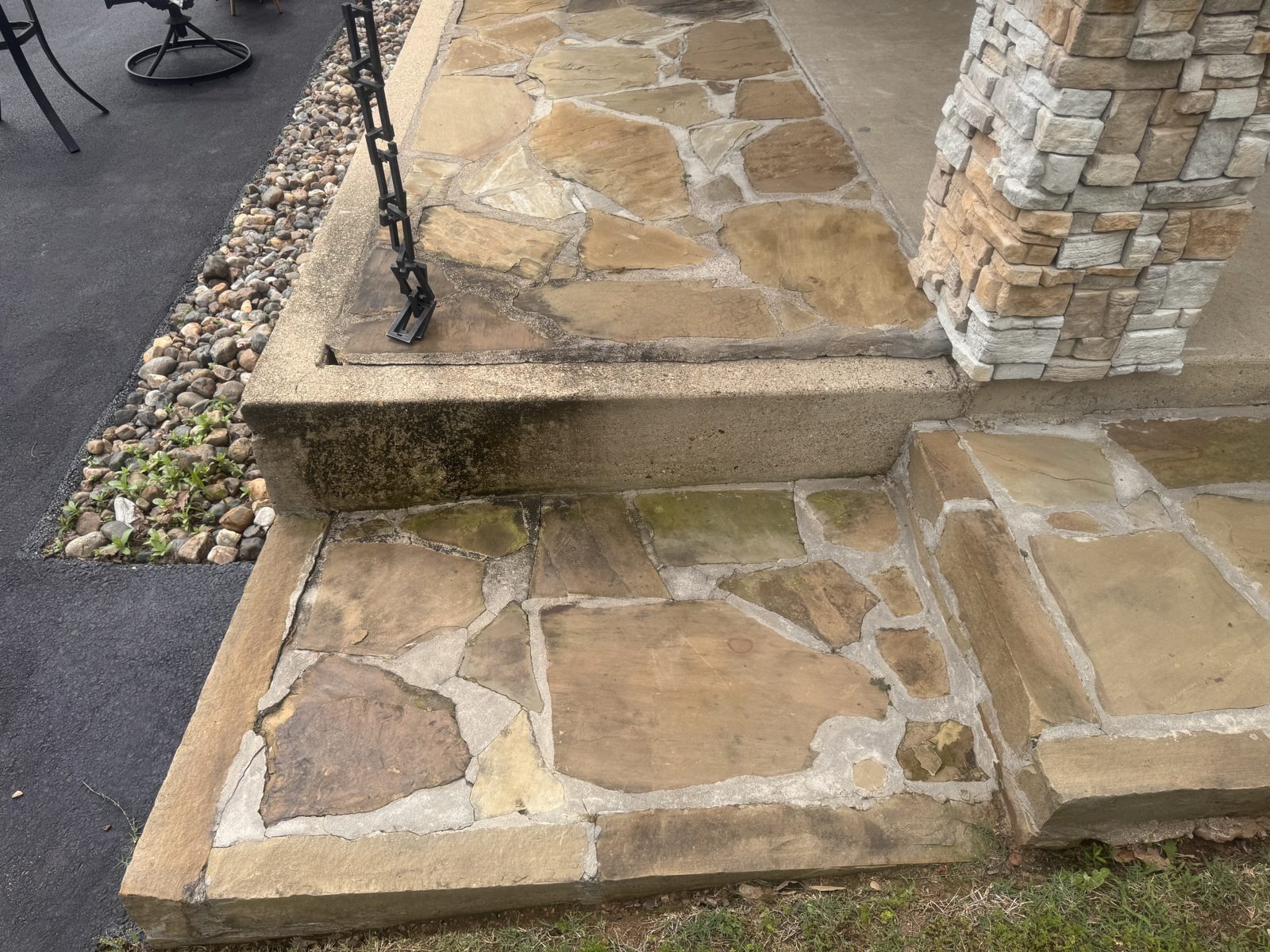
The seam where a concrete apron meets asphalt is the one people forget. Two materials, two different stains, and a joint full of packed grit between them. That seam gets wanded deliberately, and the asphalt side gets a gentler touch than the concrete, because asphalt gives up aggregate if you lean on it. Our Blanchard driveway cleaning page lays out how the field and the detail work split up.
What a Long Rural Drive Costs in Time
Blanchard lots are generous, and plenty of the properties we clean sit well back from the road on half an acre or better. A drive like that is not a bigger version of a suburban pad. It is a different kind of job, and we would rather tell you that up front than surprise you on the day.
The field scales predictably with length. What does not scale predictably is everything else. A long drive usually has more edge, often a turnaround or a parking apron, sometimes a gravel shoulder feeding grit onto the concrete, and nearly always a culvert crossing or an apron at the road that takes its own attention. Water supply and hose runs stretch out, which means more repositioning and less washing per hour.
So we walk it before we quote it, every time. We measure, we look at the finish, we find the edges and the seams, and we tell you whether it is a morning or a full day. The price we quote is the price you pay, and that only works if the walk happened first. Everything we cover in town is on the Blanchard service page.
Common Questions
Why did my last driveway cleaning leave lines in the concrete?
Passes that were not overlapped. A surface cleaner cleans a circle narrower than its housing, so the strip between two adjacent lines gets missed. Wet concrete hides it completely and the stripes show up as the slab dries, usually after the crew has gone.
Can a surface cleaner get right up to the garage door?
No, and nothing else does either. The shroud has to sit flat, so it always leaves an inch or two against a threshold, a wall or a border. That perimeter gets wanded by hand after the field is done, along with the control joints.
Does a long rural drive take a lot longer than a short one?
Longer, and not simply in proportion. The open field scales with length, while the edges, the turnaround, the road apron and the hose repositioning add up faster than the square footage suggests. We walk the drive before quoting so the time is right.
Put the Whole Drive on One Visit
Free, no-obligation quote after we walk the slab, read the finish and count the edges, field and detail work included.
Schedule a Wash Call (318) 401-2772The full scope is on our Blanchard driveway cleaning page, finished slabs are in the project gallery, and you can send us the address for a same-business-day reply.