


Three separate things land on a Haughton wall over the course of a year, and each one has its own season. Green algae builds slowly wherever the wall stays damp. Yellow pine pollen arrives in a rush in spring and bonds into a film. Brown tannin bleeds out of wet leaves and needles whenever they pile against something. Soft washing takes all three off without forcing water into the wall, and when you book it decides how long the result holds.
Folks around here ask us the same thing every March. Should they wait until the pollen quits, or should they get the house cleaned now so it looks right for company? Fair question, and the answer depends on which of the three problems is bothering them most. A wall in Bossier Parish is rarely dealing with only one at a time, and the calendar treats each one differently. Knowing which is which saves you from washing at the wrong end of a season and watching the film come right back.
Damp Is the Ingredient, Not Dirt
The green cast people find creeping up an exterior wall is a colony, not a coat of grime, and that distinction changes everything about how you get rid of it. What it wants is moisture that lingers, and Bossier Parish hands that over from spring through fall without much help. Anywhere the wall stays wet past mid-morning, something takes hold.
The practical test is easier than the science. Go out on a clear morning and put your hand flat on the wall at chest height on each side of the house. The elevation that still feels cool and slightly damp when the rest have warmed up is the one that will green first, and it is the one that will green again soonest after we leave. That is not a housekeeping problem and it is not a sign of a cheap builder. It is geometry, trees, and Louisiana air.
Because the growth is alive, force does not settle it. Knocking the visible layer off a wall leaves the part with roots down in the surface, and it repopulates over the next few warm damp weeks. Killing it outright is what buys you a year, and killing it takes a solution and a little dwell time rather than a stronger machine.

What Soft Washing Actually Means in Practice
The phrase gets used loosely enough that it is worth spelling out. Soft washing means the water pressure at the wall is somewhere close to what a garden hose delivers, and the cleaning happens chemically. A solution goes on, sits long enough to break the growth apart and loosen the film holding dirt in place, and then a gentle rinse carries everything down and off. The machine is a delivery system. It is not the tool doing the cleaning.
Compare that to the alternative and the difference shows up in places nobody looks at until later. Water driven hard at a wall goes where water is not supposed to go: past a lap of siding, behind a weep hole, through the hairline gap where a trim board meets the wall. It does not dry out in there in a Louisiana summer. It sits, and the consequence surfaces months later somewhere you cannot reach with a hose.
The surface itself also keeps a record. Vinyl dulls and chalks where a fan has dwelled too long. Painted board raises a fuzz that catches dirt faster than the smooth surface did. Mortar loses its face. None of that reverses, and none of it gets you a cleaner house, which is the part that stings. We keep the strong tips for the flatwork underfoot, which is the only thing on the property engineered to take them.
Pollen Season Has a Front Edge and a Back Edge
Spring pollen is a different animal from algae because it arrives all at once and it is not alive. When the pines let go, everything under the canopy takes a coat, and the fine dust does not simply blow away. On sun-warmed vinyl it bonds into a film. On the rough face of brick it settles into the texture and stays. A rain shower thins it and mostly relocates it down the wall, which is why so many people think a storm ought to have handled it.
The timing question is the practical one. Wash while the trees are still dropping and you get a clean wall for about a week before the next round of dust settles on it. Wait until the fall has finished, usually once the yellow film quits reappearing on parked vehicles overnight, and the same wash holds through the summer. That is the single most useful piece of scheduling advice we give homeowners here.
That said, there is a reason to wash mid-season anyway, and it is a good one. If you are hosting, listing the house, or answering a letter about the property’s appearance, get it done. The wall looks right for the event, and you can put it back on the calendar for a proper clean once the trees have settled down. Nobody has to live with a yellow house for six weeks on principle.
Tannin Is the Stain People Give Up On
Tannin bleeding out of wet leaf litter is the third problem, and it behaves like neither of the other two. Wherever oak leaves and pine needles gather and stay damp, in a roof valley, in a gutter, drifted against a foundation or a porch column, they leach a brown pigment into whatever they are resting on. It runs down in streaks. On light siding it looks like weak tea was poured over the wall. Around a column where a wet leaf sat all season it leaves a stubborn outline.
Here is where homeowners get frustrated. A general house-wash mix will lighten tannin considerably and then stop, because the chemistry that kills biological growth is not the chemistry that pulls a pigment stain out of a porous surface. Somebody who washes the house and calls the remaining brown a permanent stain is not necessarily wrong about their approach. They are wrong about the product.
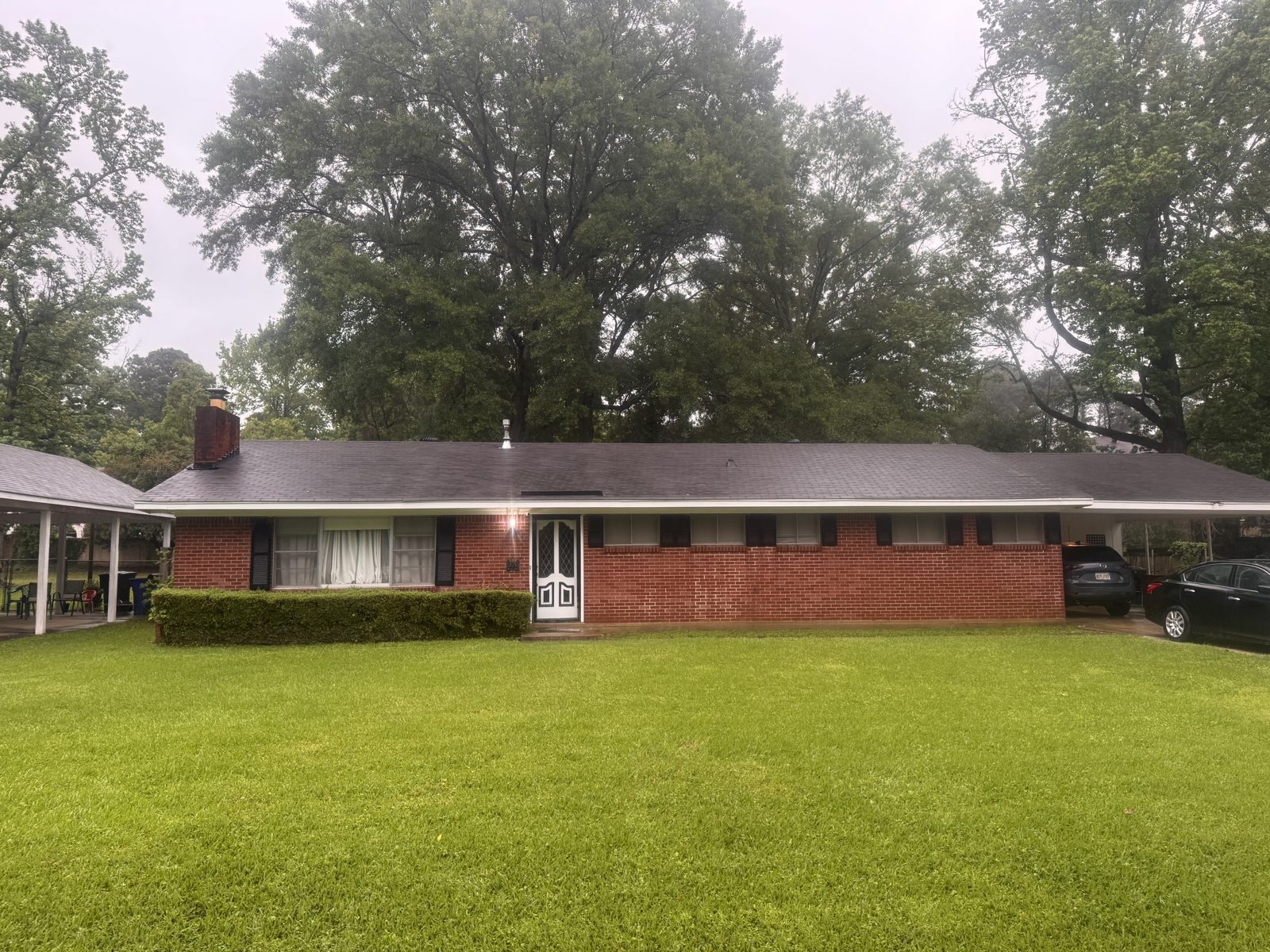
We treat those areas separately, with something built for pigment, and then rinse the treated spots into the same overall wash so the wall comes out uniform rather than patchy. The red clay band along the bottom foot or two of the wall gets the same separate handling. Three problems, three approaches, and all of it inside one visit rather than three. Our Haughton house pressure washing page walks through the full method.
Small Habits That Stretch the Interval
None of what follows costs anything, and together they add real months to how long a wash holds. Start with irrigation. A sprinkler head that clips the bottom courses of siding every other morning is watering the wall on a schedule, and that strip grows a green band while the rest of the elevation stays clean. Run the zone, stand back, and watch where the arc actually lands.
Next, look at what is stacked against the foundation. Mulch holds water by design, which is exactly what you want in a bed and exactly what you do not want touching the wall. Pull it back a few inches so the bottom of the siding stays visible and can breathe. Shrubs planted tight enough to brush the house do the same thing by trapping still air where the wall needs airflow to dry.
Last, keep leaf and needle litter from settling anywhere it can stay wet against a surface. Clearing the gutters and the corners where debris drifts is unglamorous work, and it is the single thing that keeps tannin from starting in the first place. Do those three and a shaded Haughton house that wanted washing every year will often stretch comfortably past that, which is money you keep. Have a look at the project gallery to see how walls come back once the growth is actually dead.
Common Questions
Can you wash my house while the pines are still dropping?
We can, and sometimes it is the right call if you have company coming or a deadline on a letter. Just know a fresh coat of yellow will settle within a week or so. If nothing is forcing your hand, waiting until the drop finishes gets you far more out of the same visit.
My siding looks chalky rather than green. Is that the same fix?
Different problem. Chalk that rubs off on your palm is a coating oxidizing with age, not something growing. A soft wash lifts the loose chalk and brings back more color than most folks expect, but it cannot restore paint that has aged all the way through. We tell you which one you have before you spend anything.
How long should a Haughton house go between washes?
A house with good sun on most elevations often runs comfortably past a year. One tucked under heavy pine, where a wall never fully dries, usually wants a yearly visit. One elevation typically drives the decision while the rest still looks fine, and we are happy to tell you it can wait.
Get the Green Off Your Haughton Siding
Free, no-obligation quote from a Marshall crew that works Bossier Parish every week, and never a travel charge.
Schedule a Wash Call (318) 401-2772More on the method at our Haughton house pressure washing page, see finished walls in the project gallery, or send us photos of the shaded side and we will answer the same business day.