
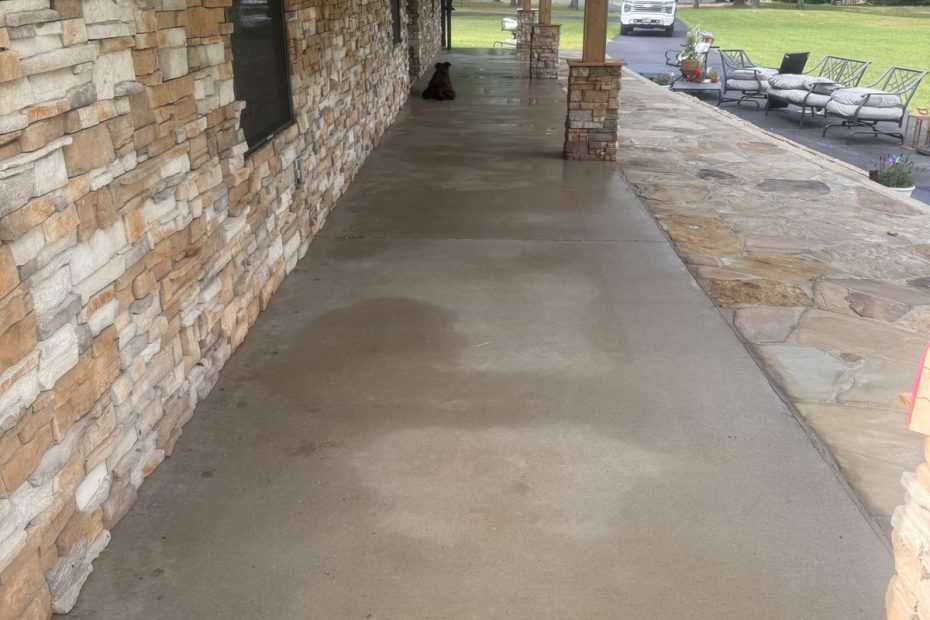

A covered porch gets dirtier than the open patio beside it because rain never touches it. Nothing ever rinses, so dust film, drifted pollen and insect residue accumulate undisturbed on the floor, the columns and the ceiling corners, and foot traffic wears a visibly darker path through the middle. We clear and protect the furniture and fixtures, wash from the ceiling down so nothing drips onto finished concrete, and do the whole slab rather than the half that looks bad.
Homeowners here are often puzzled by the same thing. The open patio off the back looks fine. The covered porch, the one with the roof over it and the furniture on it, the part of the house people actually sit in, looks worse every year. It feels backward. The sheltered area should stay cleaner. It does not, and the reason is simple once somebody points it out.
Rain Never Touches a Covered Slab
An open patio gets rinsed several dozen times a year for free. Every rain that moves through northern Caddo Parish washes the dust, the pollen and the loose organic matter off it and down the slope. It is not maintenance anybody plans. It just happens, and it is doing most of the work.
Put a roof over the same concrete and that stops entirely. Whatever lands there, stays there. Spring pollen drifts in sideways under the eave and settles. Fine dust blows in off a drive or a field and bonds into a film. Fall leaf litter collects in the corners and breaks down into a dark residue instead of washing away.
So the covered slab is accumulating year after year with nothing ever subtracting. The open one resets every few weeks. That is why the sheltered area is almost always the dirtier of the two, and why it usually needs a wash before the part that sits out in the weather does.
Columns, Ceiling Corners and What Is Overhead
The floor is what people notice and the vertical surfaces are what make a porch feel neglected. Columns collect a dust film all the way up, heaviest on the side facing the open yard, and painted or stone column bases take splash and dirt right where a hand rests.
Ceiling corners are the real find. A covered ceiling is sheltered, still, and never disturbed, which is ideal for spiders, and mud daubers build directly onto soffit panels and in the joint where the ceiling meets the beam. Nobody looks up on their own porch. We do, and there is nearly always more up there than the owner expected.
Light fixtures and fan blades belong in the same category. Pollen and dust build on the top of every blade and the upper surface of every fixture, which is the one angle you never see from a chair. Cleaning the floor and leaving all of that overhead is why some porches look washed and still feel dingy afterward.
The Traffic Path That Wears Darker Than the Edges
Walk a covered porch and look at the middle of it. There is almost always a path, a band running from the door to the steps that reads a shade or two darker than the concrete either side of it. That is not wear in the slab. It is ground-in soil.
Shoes carry grit in, pressure pushes it into the pores of the concrete, and because there is no rain to lift it, every trip adds a little more. On a broom finish the texture holds it tighter still. Over years the path becomes a permanent-looking feature that a mop or a garden hose will not move.
That path needs a slower pass and more dwell than the quiet corners of the same slab, which is exactly why one even sweep across a porch gives an uneven result. Reading the traffic pattern before starting tells us where the time goes. Our Blanchard patio cleaning page covers how a covered area is worked differently than an open one.
Working Around Furniture, Fixtures and Outlets
A porch is a furnished room without walls, and it gets treated like one. Everything movable comes off the slab before we start, because washing around a table leaves a clean island with a dirty rectangle under it. Furniture that is going back on gets rinsed down while it is off, so it is not setting dirty feet onto finished concrete an hour later.
Electrical gets respected. Outlets, switches, ceiling fans and recessed fixtures all live on a covered porch, and the method accounts for them. Covers go on where it makes sense, fixtures get wiped and hand rinsed rather than sprayed into, and no stream gets aimed up into a fan housing or a can light. Low pressure is the rule under a roof, for the fixtures as much as for the finishes.
Ceilings and columns bring their own constraint. Painted soffit panel, beadboard, stained timber and stone all want solution and a gentle rinse instead of force, which is the same logic we use on siding. Drainage is the last check: a covered slab usually falls toward one edge, and knowing which one keeps the water off a threshold and out of the house.
Ceiling First, Floor Last, Whole Slab Either Way
Order is the part that separates a finished porch from a frustrating one. The ceiling and the beams come first, then the columns and any walls, then the floor. Do it the other way around and everything that comes off overhead lands on concrete you already cleaned, and you get to do the floor twice.
Between the vertical work and the floor we clear the debris that came down, so nothing gets ground into the slab during the main pass. Then the floor runs in one continuous go with no stopping mid-slab, same as a driveway, because a pause leaves a bright patch that shows as plainly on a porch as it does on a drive.
And the whole slab gets done. Customers sometimes point at the traffic path and ask us to just handle that, which we understand and will not do, because cleaning the dirty band alone produces a clean stripe through a dirty porch that looks worse than it started. Concrete only reads right when the whole pour is even. Our other work around the area sits on the Blanchard service page.
Common Questions
Why is my covered porch dirtier than the open patio?
Because rain never rinses it. The open patio gets washed free every time a storm moves through, while the covered slab only accumulates. Dust, drifted pollen and leaf residue build up under a roof with nothing to take them away again.
Do you have to move all the furniture off the porch?
Yes, everything that moves. Washing around a table leaves a clean floor with a dirty rectangle under it. We shift it off, clean the slab in one pass, rinse the furniture while it is clear, and set it back on dry concrete.
Can a porch ceiling be washed without soaking the light fixtures?
It can. Ceilings and columns get low pressure with the solution doing the work, fixtures and fans are hand cleaned rather than sprayed into, and covers go on where they help. Nothing is ever aimed up into a housing.
Book the Porch and the Slab Together
Free, no-obligation quote covering the ceiling, the columns and the full floor, worked in the order that leaves it finished the first time.
Schedule a Wash Call (318) 401-2772The full scope is on our Blanchard patio cleaning page, finished porches are in the project gallery, and you can send us the address for a same-business-day reply.