
Pine does not fill a gutter the way an oak leaf does. Needles knit together into a packed mat that holds water in the trough instead of letting it pass, and that standing water works on the fascia and soffit from the inside while the overflow stains the slab below. Scooping the visible ends does nothing about it. The trough gets cleared and then flushed end to end, every downspout gets flow checked, and the sagging and rust streaked sections get looked at while we are up there.
Blanchard sits under pine and hardwood timber, and on the bigger lots outside town a house can have four or five mature pines within reach of the roof. Homeowners here know about fall leaf drop. What surprises people is how differently the needles behave once they are in the trough. Leaves rot down and wash through. Needles do not. They lock together, and in a few seasons the inside of a gutter stops being a channel and becomes a sponge sitting against the edge of the house.
A Needle Mat Is Not the Same as Loose Leaves
A pine needle is long, thin, waxy, and slow to break down. Drop a few thousand of them in a trough and they interlock into a dense felt that water has to push through rather than flow over. Hardwood leaves from the same canopy fill the gaps, grit off the shingles binds it, and the whole thing compacts under its own weight every time it gets wet.
The giveaway is that the gutter looks fine from the ground. A leaf pile sticks up and makes itself obvious. A mat settles flat into the bottom of the trough, level and tidy, and from the driveway the run reads as clean. People are genuinely surprised when we lift a handful out of a gutter they thought was empty.
It is also why a gutter under pine can be full while a gutter on the sunny side of the same house is nearly clear. Needles land where the canopy is. One elevation can carry years of buildup while the rest of the roof drains normally.
What Standing Water Does to Fascia and Soffit
A gutter is designed to hold water for seconds. A mat makes it hold water for days. In a humid subtropical climate that does not dry out between rains, that standing water sits in constant contact with the back wall of the trough, which is bolted directly to the fascia board behind it.
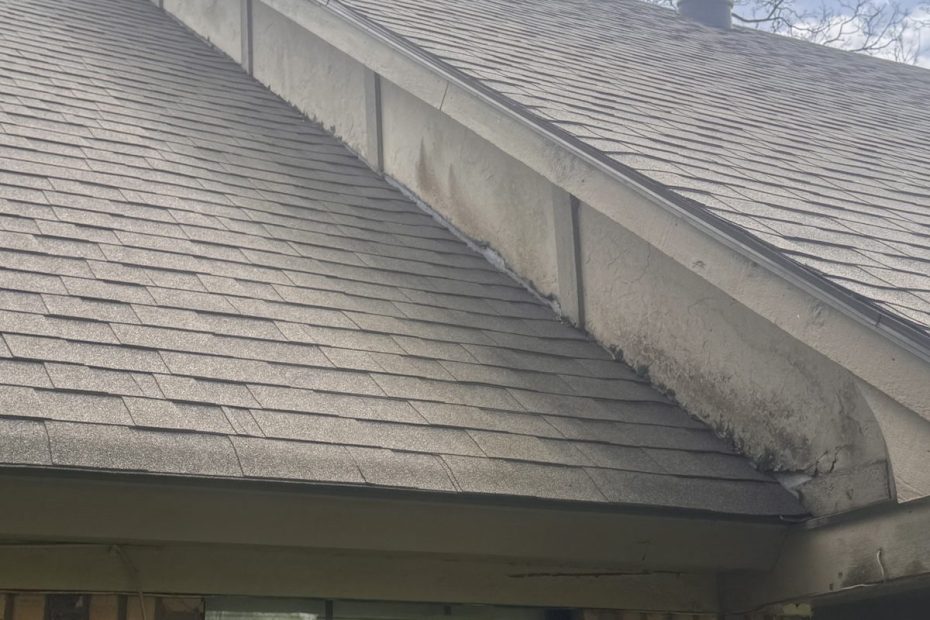
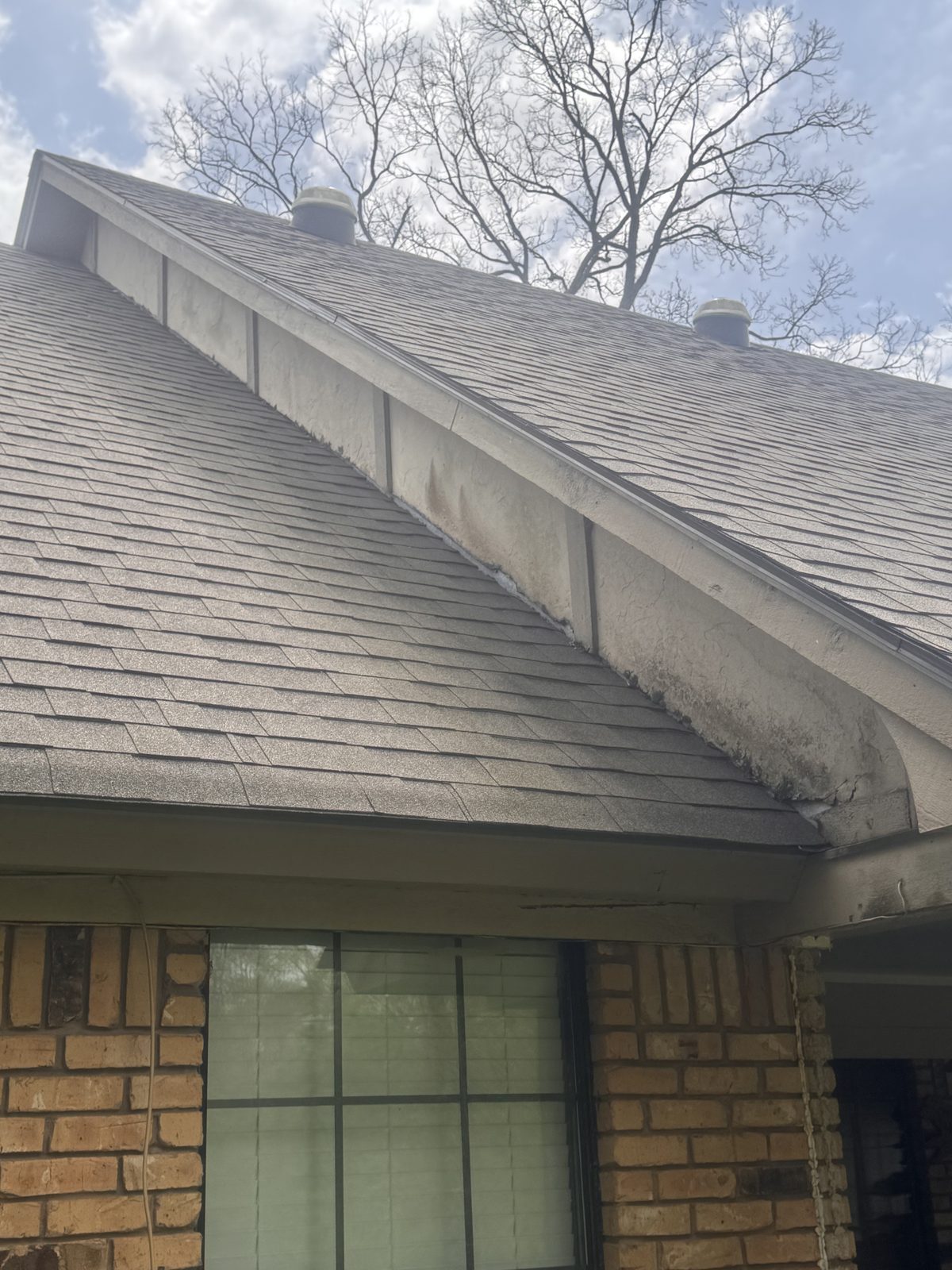
Wood held damp stays damp, and the damage starts where you cannot see it. The fascia softens from the back face first. Soffit panels take it next, because overflow coming over the back edge of the gutter runs behind the trough rather than off the front, which puts water inside the eave instead of outside it. By the time paint bubbles on the fascia, the problem has been running for a while.
Weight adds to it. A trough packed with wet needles is heavy, and that load pulls on the hangers all season. Hangers loosen, the run drops a little, and the low spot holds even more water than before. The problem feeds itself.

The Stained Waterfall Onto the Slab Below
When a mat finally blocks the trough, the water has to leave somewhere, and it leaves at the seams and the back edge. What pours over is not clean rain. It has been sitting in decomposing needles and leaf litter, which means it comes out the color of strong tea and carries fine organic sediment with it.
That is what puts a dark vertical streak down a wall and a stained fan on the concrete directly below. Tannin bonds to concrete, and a walkway or a porch slab under a chronically overflowing seam will hold the mark long after the gutter is cleared. The same water lands in whatever planting bed sits under the eave and washes the mulch out of it.
The useful part is that the stain tells you exactly where the blockage is. A streak under one corner of a long run points at a seam. A fan at a downspout means the drop itself is packed. Reading the marks from the yard saves a lot of climbing.
Flushing the Whole Run Instead of Scooping the Ends
Most gutter work gets done at the ends, because the ends are where a ladder goes easily. That clears the two feet somebody can reach and leaves the middle of the run exactly as it was. A mat does not care that the corners are clean.
The trough gets cleared along its full length first, and then it gets flushed with water, which is the part that actually settles the question. Flushing carries out the fine sediment and grit that hand clearing leaves behind, and more importantly it shows us where water goes. A run that drains instantly is clear. A run that pools anywhere has a low spot or a blockage further on. Our Blanchard gutter cleaning page covers the full sequence.
Every downspout gets its own check. A clear trough feeding a packed drop is still a blocked system, and needles jam in the elbows where the drop turns, which is the one place nobody can see from the roof or the ground. Water has to come out the bottom at full volume before we call it done.
What a Sagging or Rust Streaked Section Is Telling You
While we are on the ladder we look at the hardware, because a gutter tells on itself. A section that dips in the middle has lost hangers or had them pull through soft fascia, and that dip is a permanent water reservoir until it is reset. Catching it at the sag stage is cheaper than catching it at the fascia stage.
Rust streaking at a seam or a fastener means water has been standing there long enough to work on the metal from the inside. Separated seams, nail heads backing out, and a trough pulling away from the fascia are all the same message: the run has been carrying weight it was not built to carry.
We tell homeowners what we found and what we think it needs, with photos, and we do not pretend a cleaning fixed a structural problem. A clear gutter on a failing fascia board buys time. Knowing which one you have is worth the visit by itself. Everything we handle locally is listed on the Blanchard service page.
Common Questions
How often do gutters need clearing under pine timber?
Twice a year on a house with mature pines close to the roof, once after the fall drop and once in late spring. Pines shed year round rather than in one clean season, so a single annual visit tends to leave a mat forming through the wet months.
Can you tell a gutter is blocked without getting up there?
Often, yes. A dark streak down the wall under one spot, a stained fan on the concrete below a seam, mulch washed out of a bed at the drip line, or a section that visibly dips in the middle all point at where water is standing instead of moving.
Do gutter guards stop pine needles?
They slow the coarse debris and they do not stop needles, which are thin enough to pass through most screens or to knit into a mat on top of them. Guards change what the maintenance looks like rather than removing it, so the run still needs checking.
Clear the Troughs Before the Next Hard Rain
Free, no-obligation quote on a full run clearing and flush, with downspout flow checked and photos of anything sagging or streaked.
Schedule a Wash Call (318) 401-2772The full scope is on our Blanchard gutter cleaning page, finished properties are in the project gallery, and you can send us the address for a same-business-day reply.